Harrison Wolf
Computational research engineer and agentic systems architect.
I build high-performance computational machinery for technical problems where output verification and reliability is crucial, alongside larger consumer-oriented systems. My work consists mainly of focused custom engines for algorithmic, research, or performance-sensitive problems, and larger end-to-end systems whose architecture, interfaces, tests, and review gates I define before directing implementation typically through the orchestration of multimodal coding-agent fleets.
I’ve also started taking on a small number of paid Agent Trust Reviews. More info here.
Current work develops strict governance and reliability infrastructure for next-gen AI-agent orchestration, with machine-checkable safeguards, deterministic checks, mechanically enforced workflow gates, retained evidence, and locked decision gates programmatically reserved to the operator. The design and implementation remain in-progress.

01Systems
Neighborhood-intelligence engine
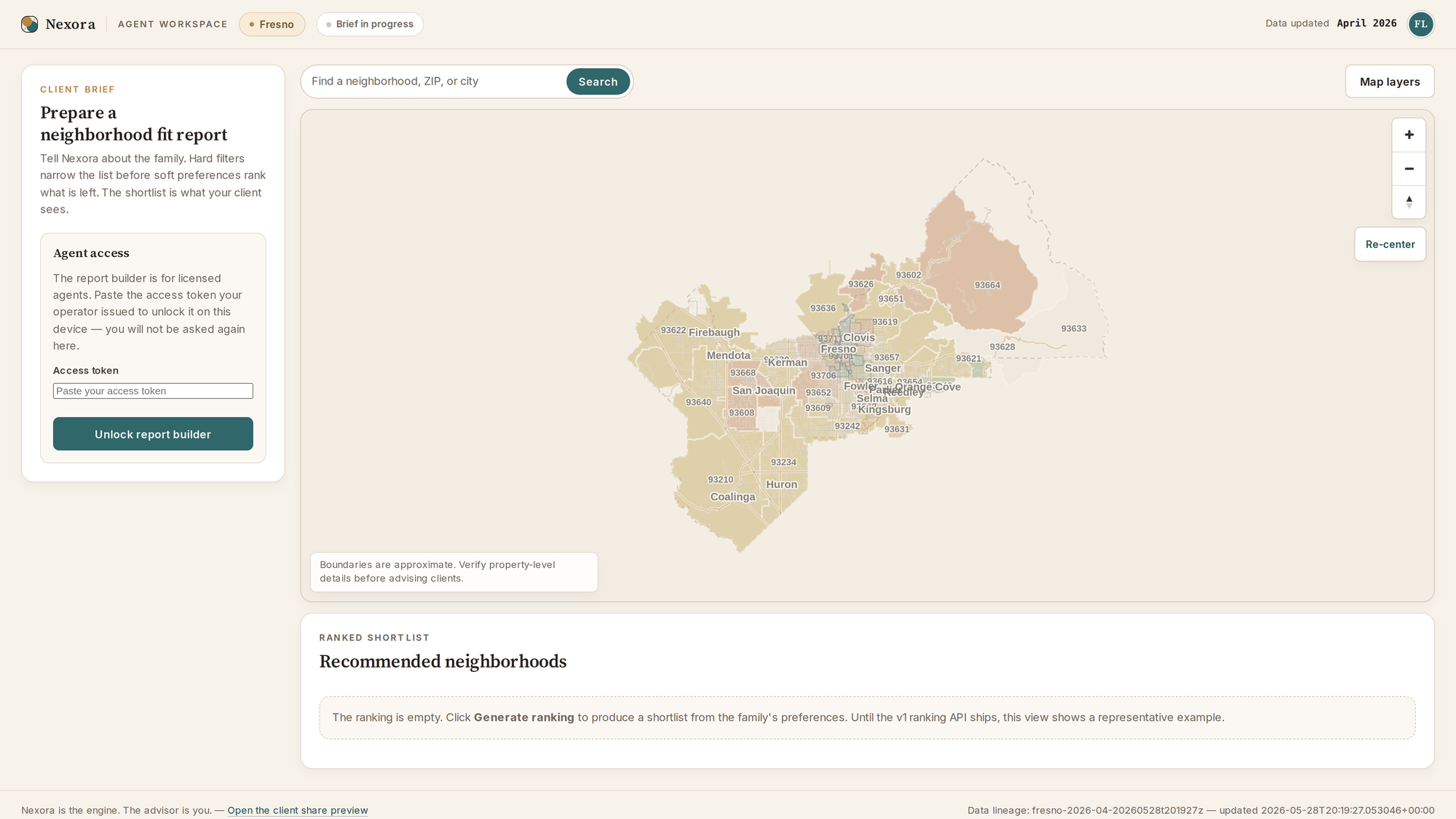
On screen, an agent workspace for choosing a neighborhood — parcels, schools, safety, and market layers over Fresno County. Underneath the interface there is a considerable amount of data engineering: an 8-stage pipeline that pulls from six external sources, including county GIS, schools, market data, and more, normalizes everything into one canonical schema, scores it with Bayesian shrinkage throughout, and publishes frozen, versioned bundles that a separate 14-table runtime serves; every number still traces back to its source file. What that discipline buys is concrete: the serving layer can only name 12 tables from an allowlist, scoring refuses to run on data normalized by older code, and the runtime refuses a bundle whose payload version doesn't match — those version mismatches raise an error instead of quietly shipping. A path-traversal hole in static file serving was caught this way and closed with a regression test that fails if it ever comes back. Multi-county spin-up is built and tested; it currently runs at one county. I designed the architecture, schema, scoring, and test gates; coding agents produced most of the implementation under a written rulebook.
The public Audit Edition is a synthetic, executable extraction of five reliability mechanisms and their tests, released under AGPL-3.0 for independent inspection.
See the map, parcel to pipeline → · The platform case study, with the schema →
Algebra search engine
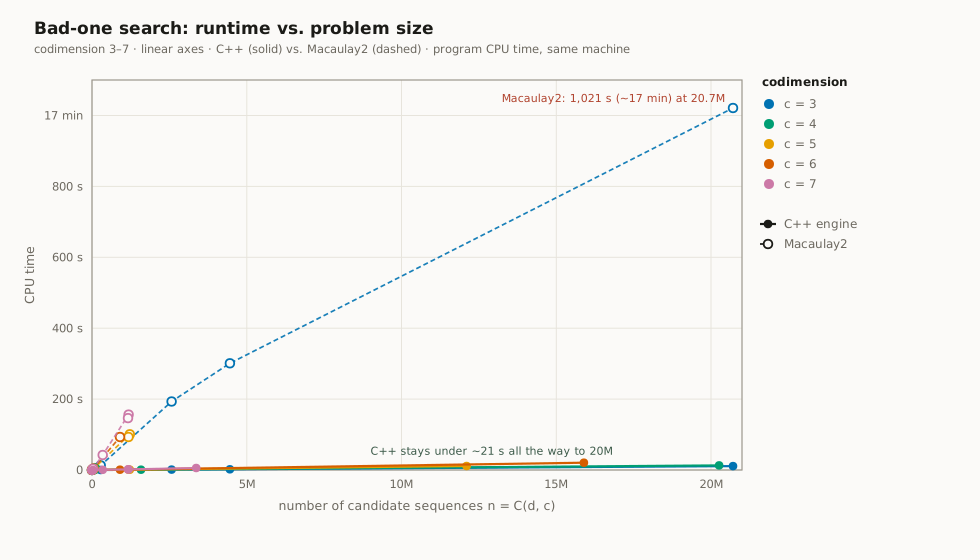
Sifts tens of billions of algebraic structures for the rare ones that break a proposed rule. I wrote the ~1,200-line C++ core by hand in 2024 and validated it case-by-case against Macaulay2, the standard tool for this work. Its exhaustive search helped surface the counterexamples behind one of the paper's three main theorems. On matched searches across codimensions 3–7 it runs 20.7 million candidates in 11 seconds, versus ~17 minutes for Macaulay2.
Video generation on an 8 GB GPU
Runs two open-weight video models on a single 8 GB GPU and chains short shots into longer clips that stay coherent, driven from a terminal UI. A resident vision-language model (Qwen3-VL, 4-bit) turns plain-language direction into runnable generation settings. The measurement layer includes seam and drift telemetry plus a blind A/B harness. Drift control between shots uses AdaIN latent anchoring (from diffusers, cited) and a custom color-matching pass. I built the orchestration, UI, and measurement; the generation models use published open weights.
Geometry engine from first principles
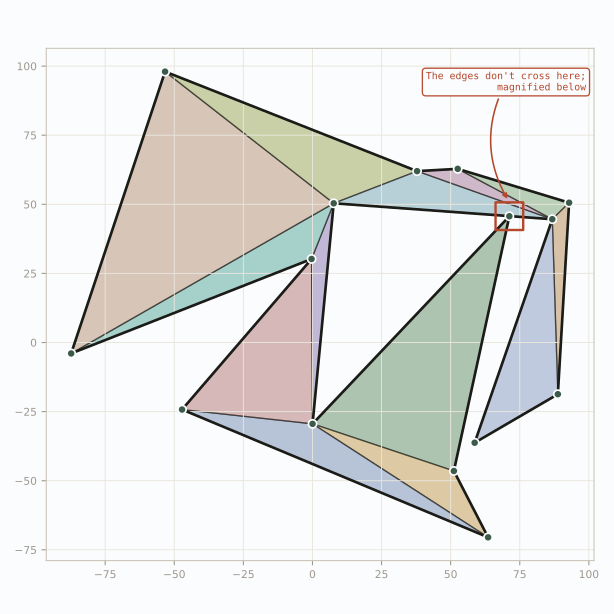
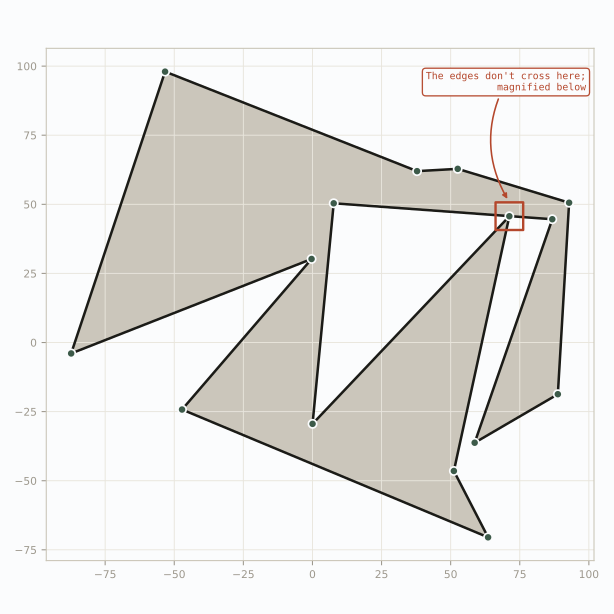
By the last checkpoint before agent-authored C++ entered the tree, I had independently built a working standard-library C++ geometry library from a bare Bash terminal using Vim and Make: 2,383 tracked C++ lines across 33 source and header files, covering points, lines, triangles, polygons, collision and containment, an original ear-clipping triangulator, random polygon generation, CLI drivers, and early visualization support. I later directed and reviewed coding-agent work that substantially revised the ear clipper and implemented the current Bowyer–Watson Delaunay and Voronoi layers, the custom TDD harness and much of its suite coverage, browser viewers, benchmarks, and terrain applications.
02Applied demo
Terrain studies
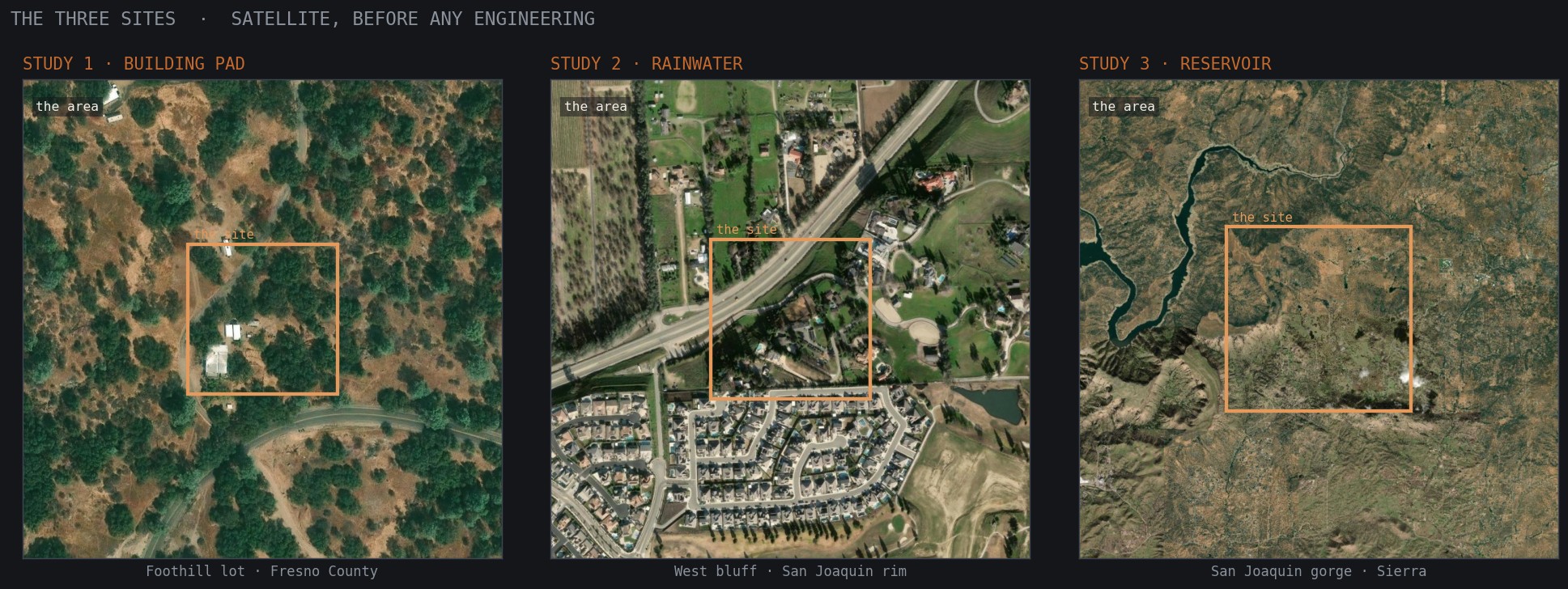
A study a landowner or agency would normally pay a survey crew and a consultant for. These preliminary estimates use free public data at three Central California sites. My geometry engine triangulates each surface from public USGS elevation and the Nexora platform can supply a real parcel boundary; neither was originally built for terrain work. Each surface is a Delaunay TIN over USGS 3DEP 10-meter elevation, and reservoir volume is integrated off the resulting stage–storage curve. Resolution for the purpose of this study is enough to scope a site, not to design one.
- A level building pad on a sloped lot, cut balancing fill: 9,160 cubic yards moved.
- A 22.2-acre bluff's rainfall routed (604k gal from a one-inch storm): which slopes shed, where the water collects, where it leaves the property.
- A dry canyon dammed at its one outlet: 44,457 acre-feet below the 329-meter waterline, about 14.5 billion gallons, closed by a 256-foot dam.
A real siting study still needs calibrated models and a licensed engineer. The harness lives in its own repo now; contact me for more.
03How I work
On compact problems, I keep the implementation small enough to reason about directly and build measurement harnesses around the parts most likely to fail. On larger work, I design and define the architecture, interfaces, and acceptance tests before orchestrating agent implementation via multimodal coding-agent fleets, then review the result against those artifacts. The algebra core is hand-written; Planar’s mixed implementation history is documented in its project entry and repository. The large-scale systems are implemented mainly via the use of coding agents; each project identifies the use of external models, algorithms, or collaborators.
04Reviews
Independent AI Agent Reliability Reviews
For founders and small teams building or deploying AI-agent systems. Each review is limited to one architecture, evaluation setup, persistent failure, deployment decision, or cost-and-reliability question. The written assessment records what the supplied evidence supports, the main assumptions and failure risks, and the 3–5 tests or controls most useful next.
The review includes up to 30 minutes of advance reading and a 75–90 minute working session. The follow-up memo states what was reviewed, the main failure risks and open questions, and any unnecessary complexity or cost.
This is a bounded independent assessment, not an implementation engagement.
- Up to 30 minutes of advance review
- A 75–90 minute working session
- A concise written decision memo
- The 3–5 highest-value next tests or controls
- A proceed, pause, or conditional recommendation within the reviewed scope
Independent technical review and engineering judgment only. Not legal advice, regulatory certification, or a compliance audit.
05Background
Boocher, Huang, Wolf. Arithmetic in the Boij–Söderberg Cone. arXiv:2512.24320 (Dec 2025).
University of San Diego, 2022–2025 — transferred in for CS, added mathematics, then made it primary and went past the major's requirements, completing three semesters of abstract algebra, two of real analysis, logic and formal methods, computational topology and geometry, combinatorics, number theory, graph theory, mathematical modeling, and more. SWE capstone 2023–24 (lead dev, auth and access control).
DePaul University, 2021–2022 — Dean's List; CS coursework (algorithms, computer systems, cryptology, databases, OOP).
Clovis Community College, 2019–2021 — A.S. Computer Science, A.S. Mathematics.
Proficient: C/C++, Python, algorithms, hardware-constrained systems, AI-agent orchestration, testing and evaluation, Git, Linux.
Familiar: PyTorch and diffusion internals, Docker, SQLite pipelines, LLM-agent and JSON-protocol design, evaluation harnesses, quantization and model offloading.
Brown belt in judo, earned in three years; my club's 2025 Judoka of the Year. At my Greek Orthodox parish I serve as a lector, acolyte, and chanter.