Nexora · case study
Neighborhood intelligence, county-first
Engineering case study
A family picker on the surface.
A county-scale analytics engine underneath.
Nexora ranks neighborhoods in a county against a family's stated budget and priorities for real-estate agents. The picker is the interface; this page documents the data pipeline, scoring, and serving runtime behind it.
- Role
- architecture, schema, scoring, and test gates; implementation mainly through coding agents
- Status
- private product repository
- Inspect
- public Audit Edition
The system, in numbers
Current implementation, measured from the codebase
The current system uses Python 3.12 and SQLite. Its three Python dependencies are Shapely for geometry, WeasyPrint for PDF reports, and Pillow for images; the map client is vendored MapLibre GL. It requires no npm or Node build, cloud service, or external database.
The face
What a buyer's agent sees
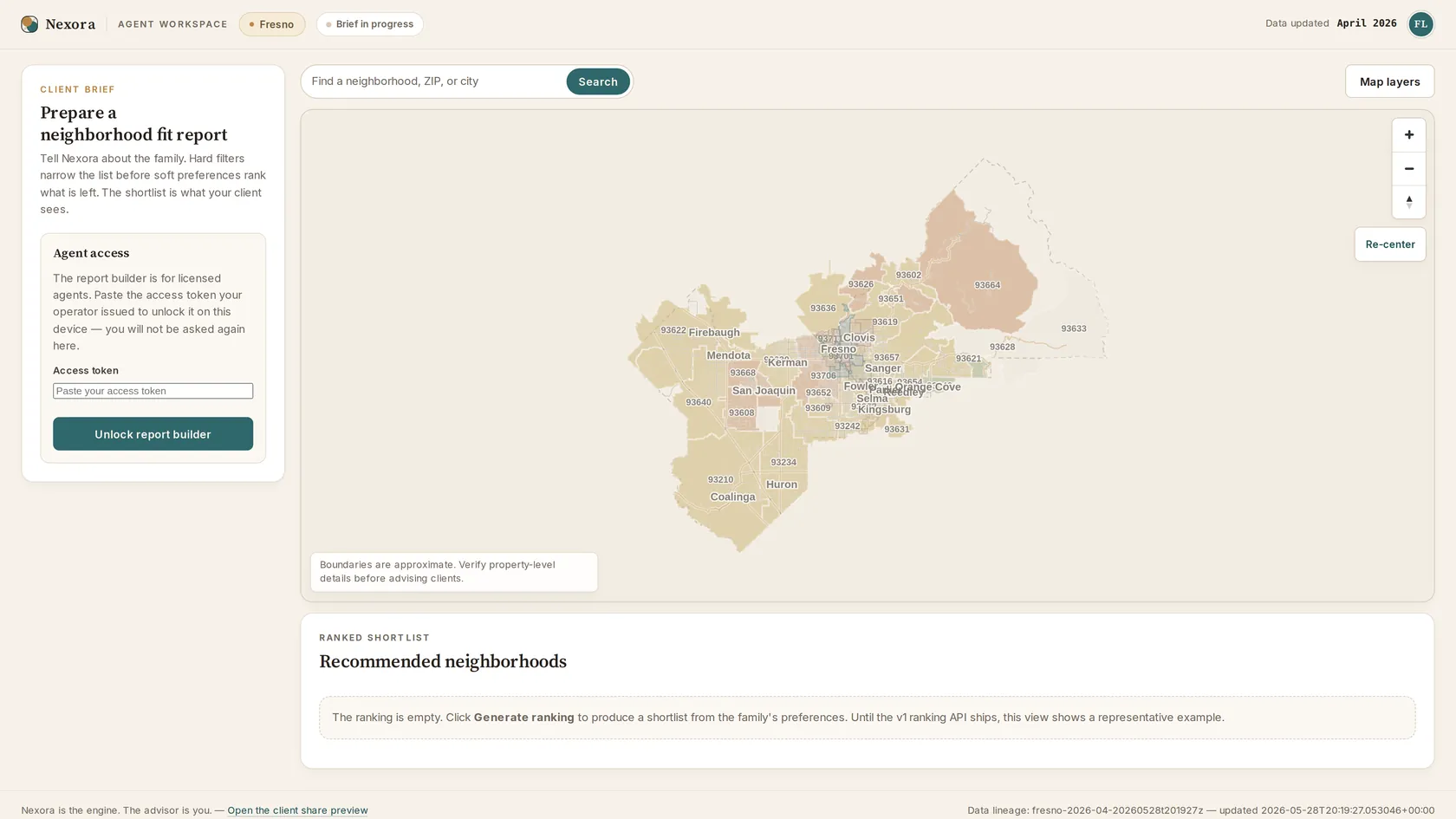
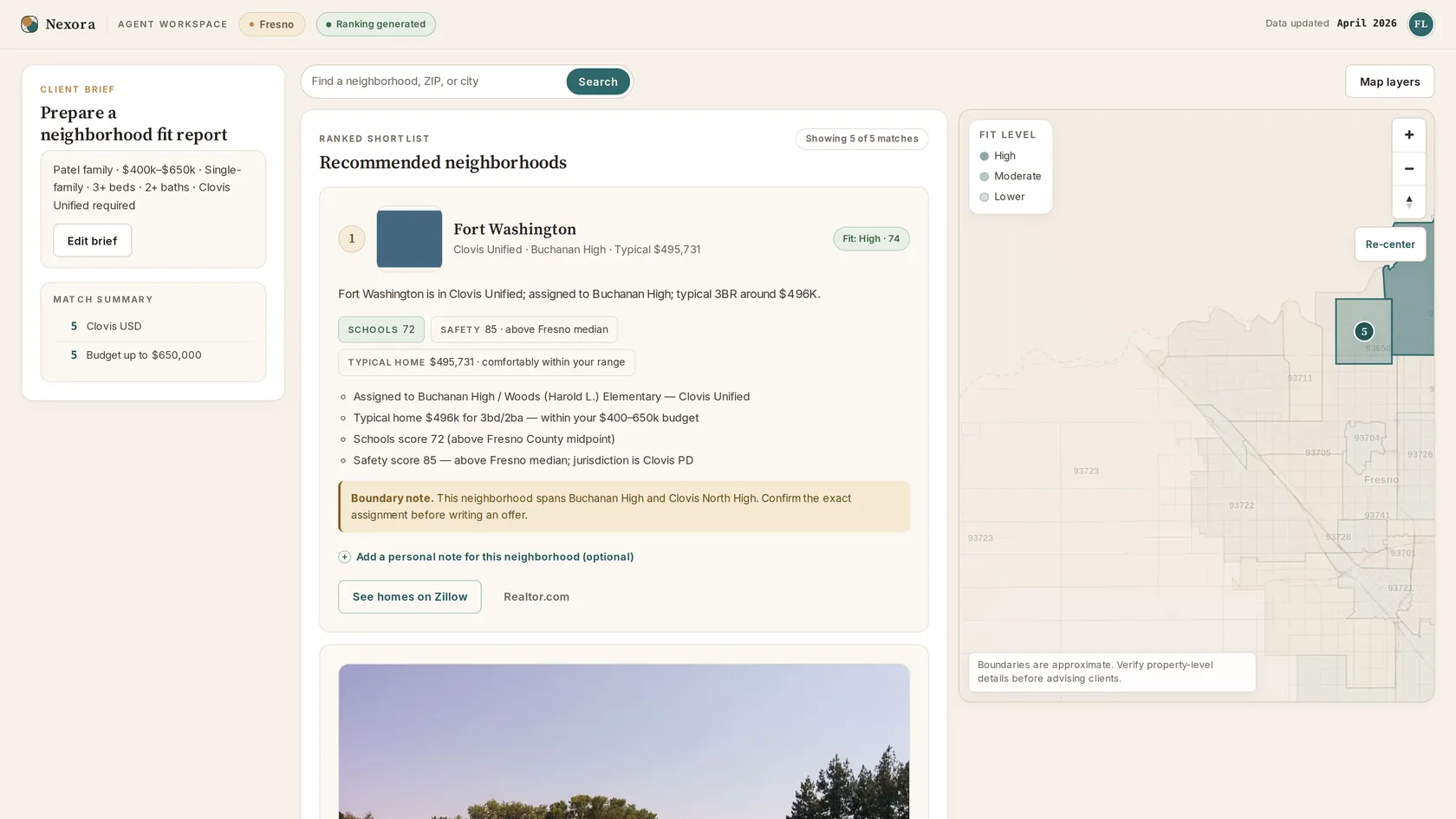
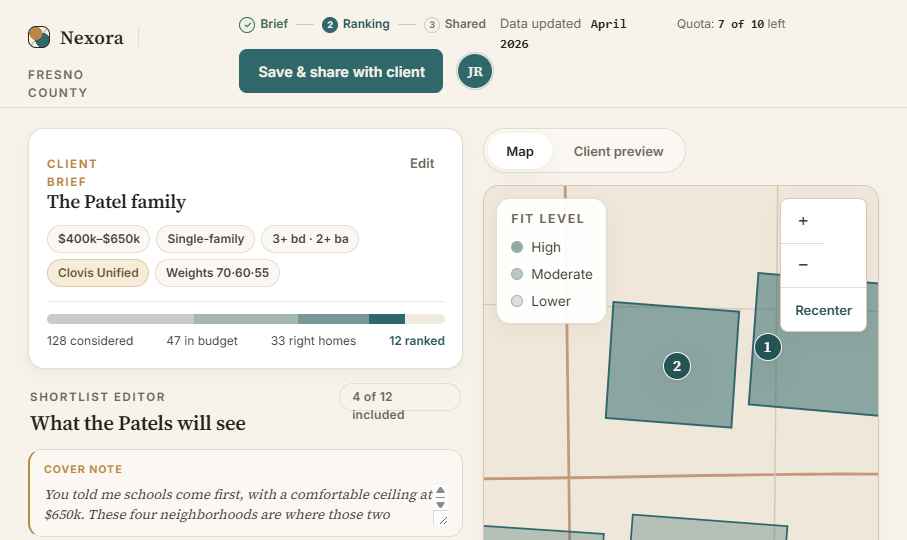
An agent describes the family once — budget, beds, school district, priorities. Hard constraints filter the county; soft preferences weight what's left; the result is a ranked shortlist with plain-language reasons an agent can hand to a client.
Every card carries its evidence: assigned schools with scores, safety relative to the county median, typical home price against the family's range — and honest caveats, like a neighborhood that straddles two attendance boundaries.
One click turns the shortlist into a branded share link or a print-ready PDF report.
The platform
Eight stages between a county website and a ranked answer
Data moves one direction through hard boundaries: source quirks die in the first two stages, scorers only ever see canonical facts, and the web runtime only ever reads frozen, versioned bundles. No stage can peek upstream.
- 1
Extract raw, hashed on arrival
Payloads pulled from county GIS services and public datasets — every file SHA-256-fingerprinted the moment it lands.
- 2
Adapt quirks end here
Each source family becomes a structured, versioned artifact. Downstream code never sees a source's file format again.
- 3
Normalize one canonical schema
Adapted records land in canonical tables; every run is stamped with the normalizer version that produced it.
- 4
Snapshot geometry, frozen
For a county and month: clipped polygons, hex-cell grids, school-attendance overlaps — computed once, then immutable.
- 5
Score with confidence labels
Market state per hex cell; schools and safety per neighborhood. Thin evidence shrinks estimates toward neutral instead of overclaiming.
- 6
Publish sealed bundles
Scored results become a self-contained, versioned bundle — manifest, payloads, map thumbnails — tracked in a publication index.
- 7
Bootstrap fail-closed
The runtime database is rebuilt from the latest bundle. A version mismatch refuses to load — there is no silent legacy fallback.
- 8
Serve rank at request time
A lightweight web runtime ranks against each family's preferences live, and renders the map UI, share links, and PDFs.
Scorers never see raw data. The runtime never sees the pipeline. Refreshing a county is one command.
Source lineage
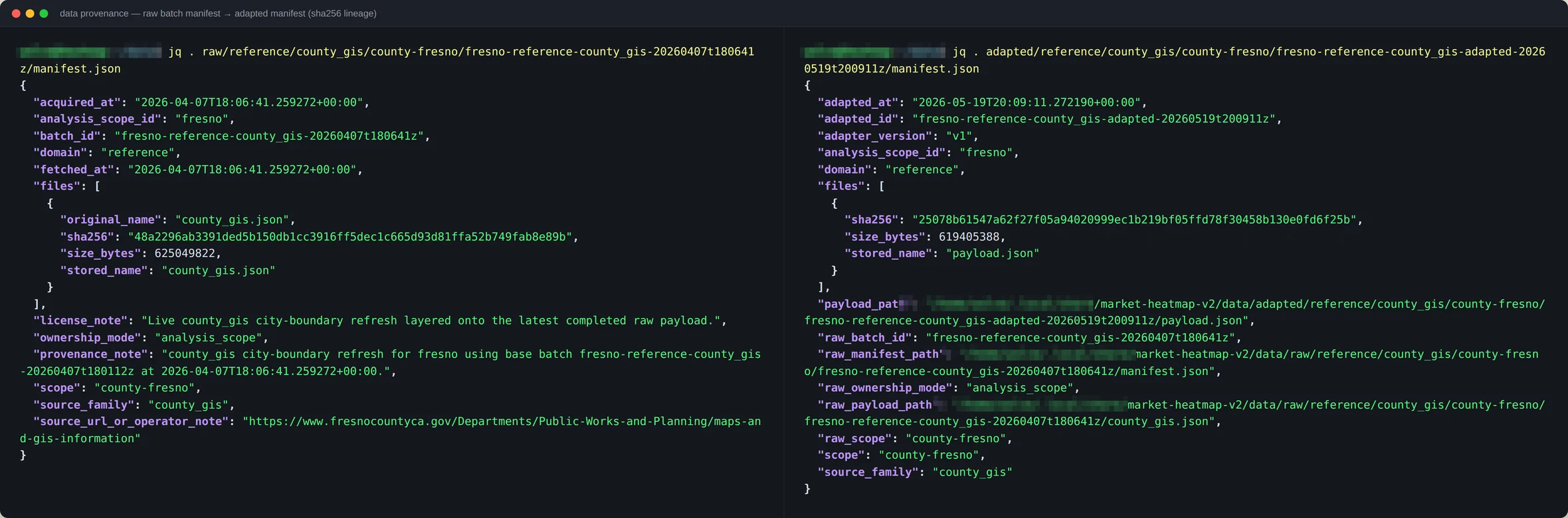
Published values retain their source lineage
Families make six-figure decisions on this output, so every artifact records what it came from, when, under which code version, and with what fingerprint. Below, one real lineage pair: a raw county-GIS batch and the adapted artifact derived from it.
- Fail-closed version gates. The normal scoring path rejects data normalized by an older schema version; the runtime rejects bundles with a mismatched payload version and reports the mismatch.
- Shrinkage on thin data. Estimates shrink toward neutral in proportion to sample support (n / (n + k)); where coverage is too thin, the score is suppressed outright.
- No fabricated commute scores. The UI collects a family's commute constraints, and the easy move was to fake the rest — zero-fill the data and ship a commute weight slider anyway. Instead the slider is withheld until real commute data lands.
- Atomic report limits. Per-agent report quotas use a single guarded insert, covered by a two-thread test that fires simultaneous requests at the limit.
- Tests outweigh the code. 948 cases, written fail-before / pass-after. The suite covers the pipeline, the scoring math, the HTTP surface, and the race conditions.
The schema, in the open
Schema and runtime boundaries
The table names below are generated from the current schema and grouped by layer. Their prefixes mark boundaries enforced in code: source-specific data is separated from canonical facts, snapshots, scores, and the 14-table serving runtime.
meta_analysis_scopemeta_analysis_scope_sourcemeta_citymeta_countymeta_county_reference_foundationmeta_county_source_policymeta_county_zipmeta_layermeta_normalization_runmeta_publication_buildmeta_score_buildmeta_snapshot_buildmeta_source_batchref_agent_tokenref_city_boundaryref_county_boundaryref_neighborhoodref_neighborhood_school_assignmentref_parcelref_parkref_reference_pointref_road_segmentref_schoolref_school_attendance_arearef_school_districtref_school_zoneref_zip_arearef_zoning_areaobs_assessment_observationobs_listing_eventobs_permit_eventobs_sale_eventobs_school_metricobs_vendor_property_observationobs_zip_market_monthobs_zip_sale_observationsnapshotsnapshot_areasnapshot_area_parentsnapshot_parcel_assignmentsnapshot_parcel_centroidsnapshot_parcel_salesnapshot_partition_definitionsnapshot_reference_layersnapshot_rent_observationsnapshot_sale_observationsnapshot_serving_contextsnapshot_source_familysnapshot_zip_tightness_observationscore_area_month_explanationscore_area_month_market_statescore_neighborhood_qualityscore_zip_safetyruntime_cellruntime_cell_detailruntime_data_provenanceruntime_manifestruntime_neighborhoodruntime_neighborhood_school_assignmentruntime_parcel_centroidruntime_parcel_saleruntime_reference_layerruntime_saved_reportruntime_schoolruntime_school_attendance_arearuntime_zipruntime_zip_detailgenerated from the CREATE TABLE statements in storage.py · 67 tables · 53 canonical, 14 runtime
Below the waterline
Built into the engine, not yet in the picker
The family picker deliberately surfaces a fraction of what the platform computes. The rest is implemented in the current serving runtime, one toggle or one data feed away.
Hex-cell market heat map
Heat, tightness, trend, and acceleration scored per hex cell across the county — an investor's layer, dark by default in the family product.
Parcel-level inspector
Parcel geometry with APN, address, and sale history behind a disabled map layer.
New-county spin-up
The registry-driven path covers boundary validation, ZIP baselines, and GIS profiles without changing engine code. Fresno is the only county run end to end.
Longitudinal vintages
Monthly publications are indexed and retained. The runtime serves the latest; a time-series interface is not implemented.
Known limits
Current limits
- Data staleness at serve time warns the operator but doesn't block serving — keeping data fresh is left to the operator.
- Multi-county support is tested but has never run against more than one county for real.
- Bundle versioning catches version mismatches, but a payload shape change within a version would slip through — a known gap, flagged in the repo's own docs.
Public audit surface
Inspect the reliability mechanisms
The product repository remains private. The public Nexora Audit Edition is a synthetic, executable extraction of five reliability mechanisms. I directed the extraction and adversarial review; coding agents produced most of the implementation under executable tests and release gates. Version 0.1.1 includes the tests, machine-readable claims, source map, known limitations, and correction record, but no product interface, real data, production configuration, or private history. It is released under AGPL-3.0-only.